Jada Studio · Marrakech
Renovating a riad in Marrakech
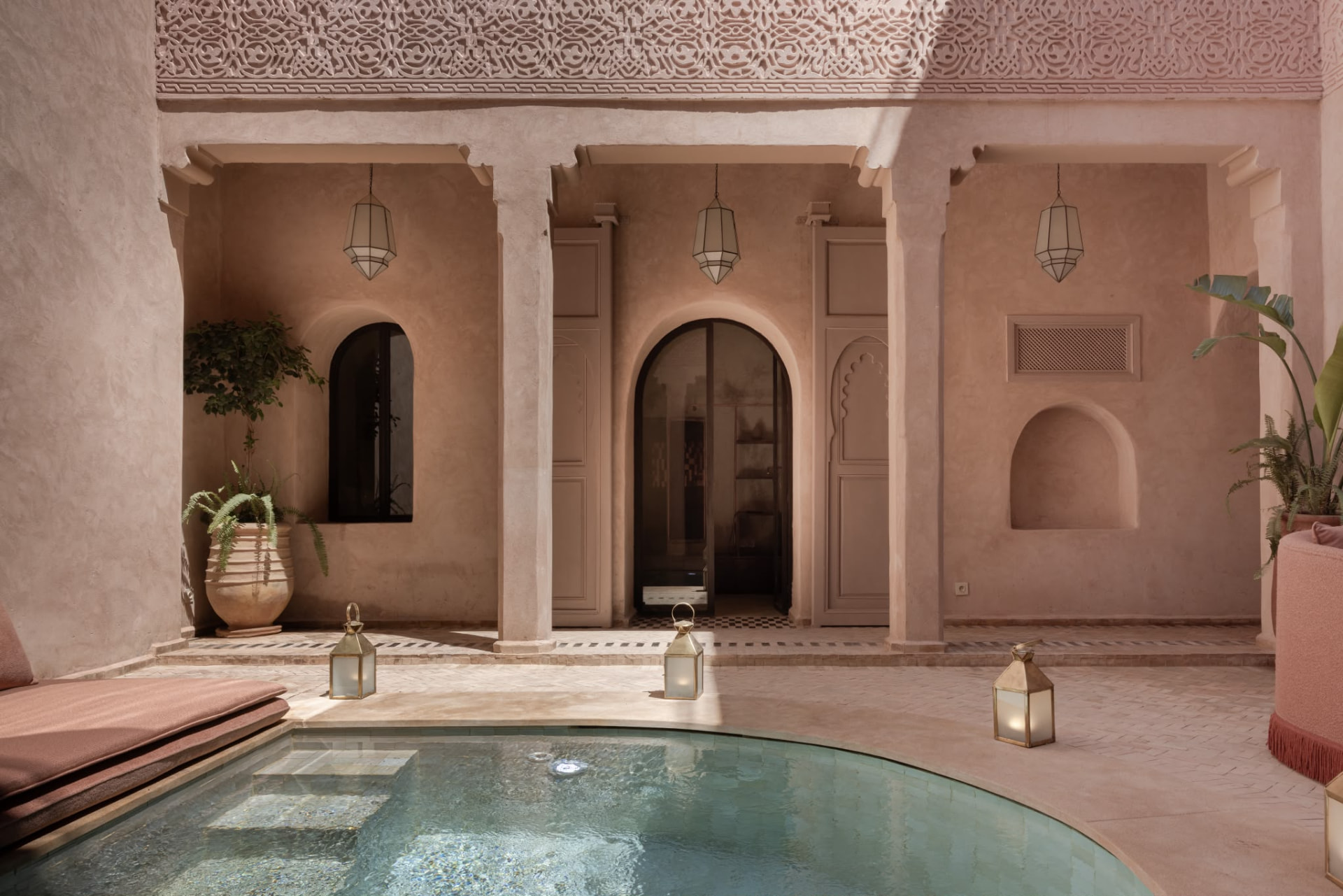
A riad is not an ordinary house. Rooms turn inwards around a courtyard, walls are made of earth and lime rather than concrete, and every trade that touches them is a craft passed down by hand. That is what makes these houses beautiful, and what makes renovating one in the medina of Marrakech quite unlike a renovation in Europe.
This is what we have learned accompanying owners through their projects: the order things happen in, the trades involved, and the questions worth asking before you sign anything.
Before you buy: what to look at in a riad
Most of the surprises in a renovation are decided on the day of purchase. Before committing, we look at the structure, the water and the light, because those three are expensive to change and everything else is not.
- Structure: the state of the walls, beams and terrace slab, and whether floors have moved.
- Water: rising damp in the lower walls, drainage in the courtyard, and the condition of the mains connection.
- Light: how the courtyard brings daylight into the rooms, and which rooms will always stay dark.
- Access: how far from a vehicle drop-off the house sits, since in the medina every sack of plaster arrives by cart or by donkey.
- Paperwork: a clear title, the surface actually built, and whether previous works were declared.
How a renovation unfolds
Work usually runs in the same order: survey and drawings, then structural repairs and networks, then the finishing crafts, and finally the furnishing. Skipping ahead is the most common way to pay twice, because tadelakt and zellige are laid last and will not forgive a pipe that has to be reopened.
In practice, a full riad renovation in Marrakech takes several months on site once drawings are settled, and the calendar bends around Ramadan, summer heat and the pace of each workshop.
The crafts that make a riad
The character of a riad comes from a handful of Moroccan crafts, each with its own workshop and its own rhythm.
- Tadelakt: polished lime plaster, waterproof and warm, used in hammams, bathrooms and whole walls.
- Zellige: hand-cut glazed tiles, laid piece by piece, with the small irregularities that give a floor its life.
- Carved plaster and wood: friezes, arches, doors and mashrabiya screens shaped on site.
- Brass and ironwork: lanterns, taps, railings and made-to-measure lighting.
Interior design that suits the house
Our approach to interior design in Marrakech starts with the house rather than a style board: where the light lands during the day, what the existing materials want to be, and how the family or the guests will actually move through the rooms. From there we draw plans, elevations and bespoke furniture, and choose the materials with the artisans who will make them.
A riad can be soft and contemporary, or deeply traditional. What matters is that the choices hold together, and that they can be built by the workshops around the corner.
Budget, and where it actually goes
Every riad differs, so we do not publish a price per square metre we could not stand behind. What we can say is where the money tends to go: structure and waterproofing first, then networks, then the finishing crafts, which is where quality is visible and where cutting back shows soonest. Bespoke furniture and lighting come last and are the easiest to phase over time.
We are happy to look at a specific house with you and give you a realistic reading of it before you commit.
Why site follow-up matters
In the medina, a renovation is a succession of small decisions taken in front of a wall. Someone has to be there each week to take them, to check that the plaster is the right mix and the tiles the right cut, and to tell you honestly how the work is progressing. That weekly presence, more than any drawing, is what makes the difference between a house that is finished and a house that is finished well.